
Owing to their immigration status, Venezuelan migrants in Trinidad and Tobago often face harsher working conditions and work longer hours than their Trinidadian counterparts.
While many are grateful to have jobs, they are often also underpaid, leaving them struggling to provide for themselves and their families.
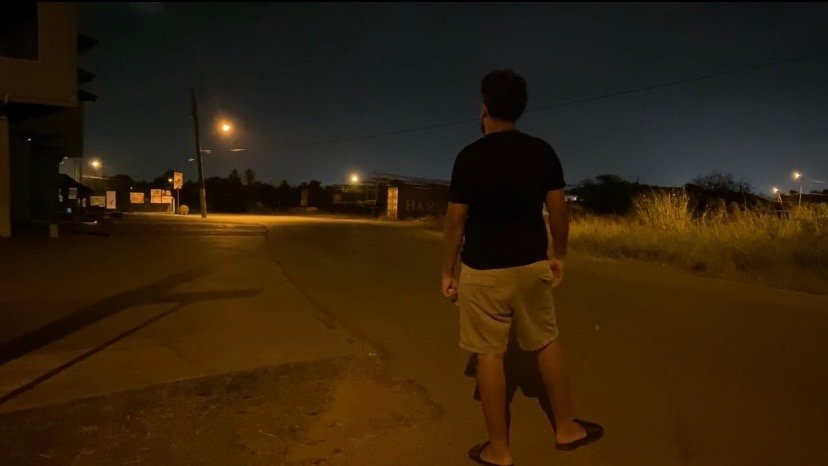
Another fallout of their longer working hours is the trouble for transportation.
In an interview with News 19 TT, Angie Ramnarine, co-ordinator of the La Romaine Migrant Support group, said many Venezuelans live in rural areas and their late working hours make it more difficult to find transportation.
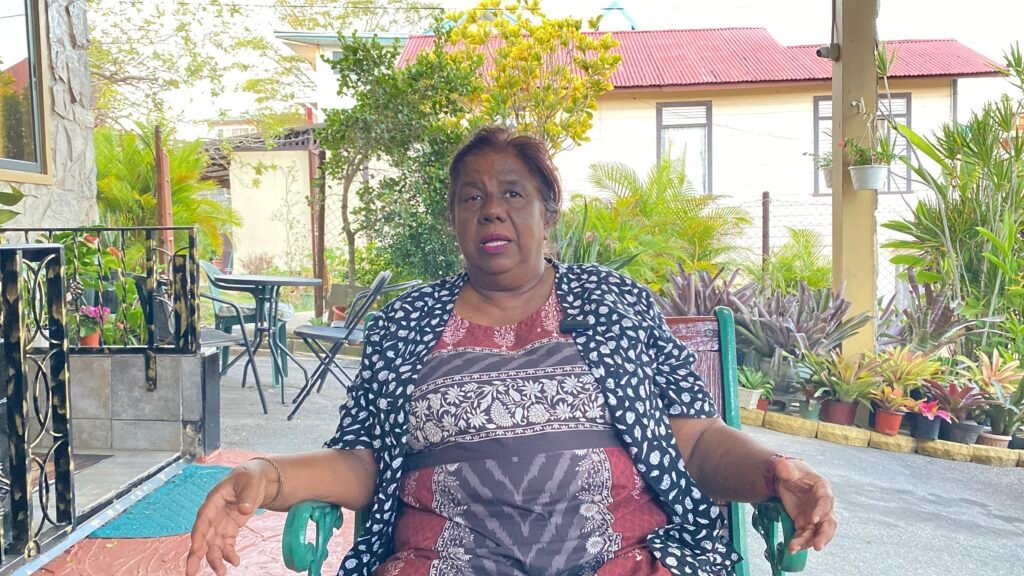
“There are people who sometimes work in factories and the factories work shifts and when the shifts are done late, they have problems getting transport late at night,” she said.
“It’s just you don’t get taxis and especially if it’s late night and a public holiday.”
Luis (not his real name) has been living and working in Trinidad for several years with his wife and two children.
He said his trade requires large, bulky tools, and he cannot afford to pay a taxi to take him around when he has jobs.
He said this led him to buy his own car. But he does not have a driver’s permit, as he cannot meet the requirements owing to his immigration status.
Ramnarine said migrants like Luis are designated as illegal in the country.
“I drive illegal, I no drive legal,” Luis said.
He said his obligation to provide for his family trumps the anxiety he feels driving unlicensed.

“Is a real problem for me, is necessary for me,,” he said.
Ramnarine translated when Luis lapsed into Spanish to explain.
“He has to maintain his family, he needs his car to move his tools to earn a living,” she said.
He said he has been arrested several times by police but each time, he was not charged.
“What he’s trying to explain ,and this is common among those who have been arrested, they say some policemen will treat it differently than others, so there is not a uniformity of sanctions among policemen and he said thank god he got good policemen who kinda gave him a bligh,” Ramnarine said.
Asked why he does not pay a taxi to take him around when he has jobs, Luis said he earns around $400 on one job.
“Example, I tell one customer $400 in Chaguanas, taxi going and going back $200, my material, gas, solder, everything, what happen to me?” he asked.
Ramnarine said when Luis gives a customer a quote, he includes the cost of the material to do the job.
“If he has to pay $200 for a taxi, the other $200 is like nothing for him, because he has already bought the material,” she said.
She translated as Luis explained that if he gets jobs that he deems too risky to drive to, he tries to make arrangements with his clients for transportation.
She said in those cases, he would be unsure of how much to charge his client and oftentimes ends up underpaid.
Luis said his vehicle has been inspected and he has an insurance policy. He said he did not know that the policy would be invalid as he does not have a driver’s permit.
He said he does not get work every day and shouldering the brunt of his family’s finances is difficult.
“I pay rent, I pay food, I pay internet, I pay light, I pay everything from my work alone,” he said.
He said his monthly expenses exceed $4,0000 monthly, which he struggles to make.
He is eager to get a driver’s licence.
“He (said he) complies with every other law. If they allow him a licence, he has no problem obtaining a licence legally, and paying for it even though that cost is attached, just to be on the right side of the law but the law is not like that,” Ramnarine said.
Another Venezuelan man, Carlos (not his real name), said he too faces challenges finding transportation.
He does landscaping, cutting grass with a weed wacker wherever he finds work.
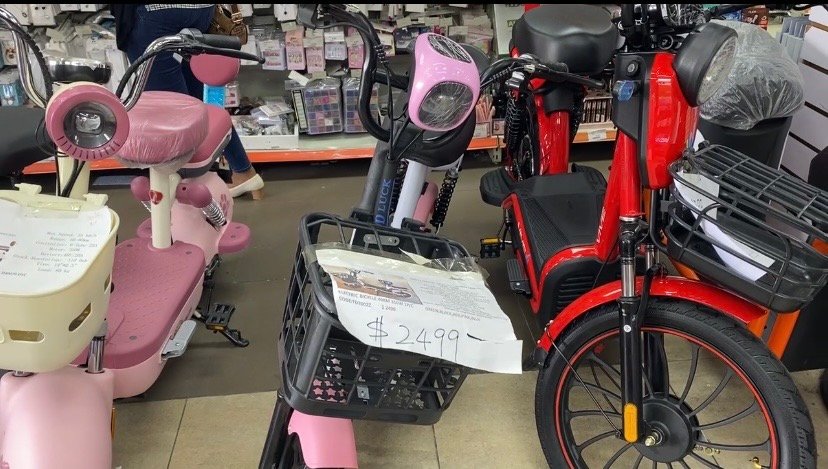
He had already started shopping around for an electric bicycle several weeks ago when the T&T Police Service announced regulations regarding the use of the e-bikes.
“He said he had already gone to buy the bike but he did not get through because they did not have the model he wanted,” Ramnarine said.
Carlos said many of his countrymen, especially those who live and work in Central Trinidad, had already bought the e-bikes.
“In Chaguanas, he said, at least 50 per cent of the people he knows have already bought bicycles and he said this will save them time and money to get to work,” Ramnarine said.
“This recent announcement of the licences, they have them stuck, they feel very powerless now..they can’t move.”
Luis said those who already bought e-bikes cannot use them and because of the requirement to register them, they are unable to sell them.
“They have to take taxis and they just spent money buying bicycles, and they can’t sell the bicycles they bought because nobody is buying it, so who will they sell it to? And transport will be very difficult,” Ramnarine said.
Luis said many opted for the e-bikes as those are less physically tiring than regular bicycles and most come equipped with baskets for transporting tools and other items.
“He said also he works with tools and the electric bicycle was able to carry his tools much better, even in a taxi, when people tell him to come and wacker their place, the taxis don’t want to take the wacker,” Ramnarine said.
In Part Two- Restricted movement: Inside T&T’s E-bike registration policy, Transport Commissioner Clive Clark explains the new policy and reveals how many people have heeded the call to register their e-bikes.
What are the regulations for e-bikes?
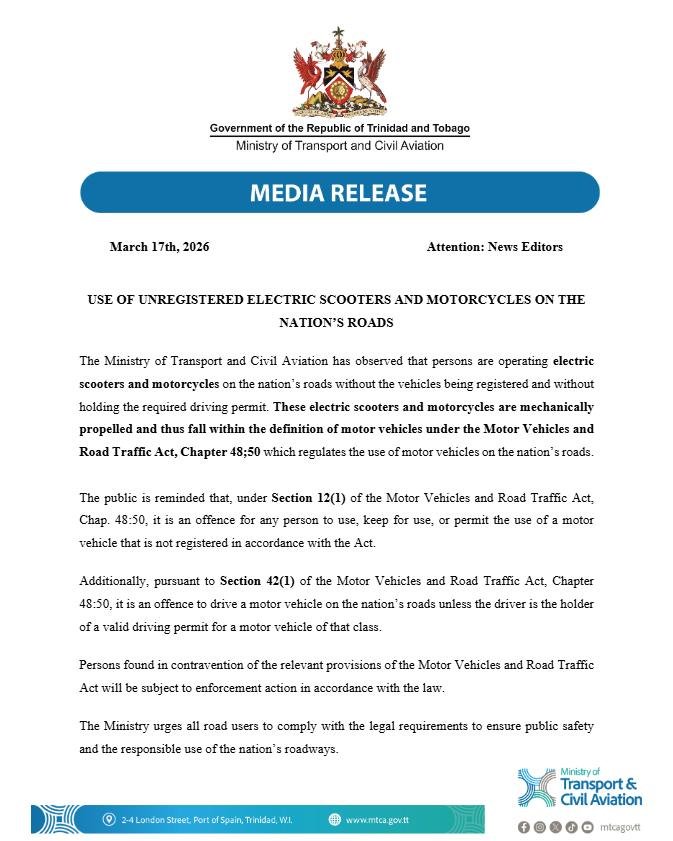
In a release on March 17, 2026, the Ministry of Transport and Civil Aviation said it had noted the use of unregistered electric scooters and motorcycles on the nation’s roads.
“These electric scooters and motorcycles are mechanically propelled and thus fall within the definition of motor vehicles under the Motor Vehicles and Road Traffic Act, Chapter 48:50 which regulates the use of motor vehicles on the nation’s roads,” the ministry said.
It said under Section 12(1) of the Motor Vehicles and Road Traffic Act, Chapter 48:50, it is illegal for anyone to use, keep for use or permit the use of a motor vehicle not registered under the Act.
“Additionally, pursuant to Section 42(1) of the Motor Vehicles and Road Traffic Act, Chapter 48:50, it is an offence to drive a motor vehicle on the nation’s roads unless the driver is the holder of a valid driving permit for a motor vehicle of that class.”
The ministry warned that anyone who breaks this law can be prosecuted.
[…] 2- Restricted movement: Inside T&T’s e-bike policy Part 1- Restricted movement: Inside T&T’s E-bike registration policy Coming soon- Restricted movement: Inside T&T’s e-bike policy Part Two- Promises unmet: […]